Showing posts with label F138. Show all posts

Thursday, March 14, 2013

Ferrari Winter Testing Upgrades Report


Ferrari was one of the first teams to introduce their major upgrade. On the second day of the second test in Barcelona, once the rain had stopped we saw part of the upgrade package, as some more parts were tested in the last day of the test and the rest of the parts will be tested tomorrow Friday 15/03/2013 during free practise of the Australian GP.
  
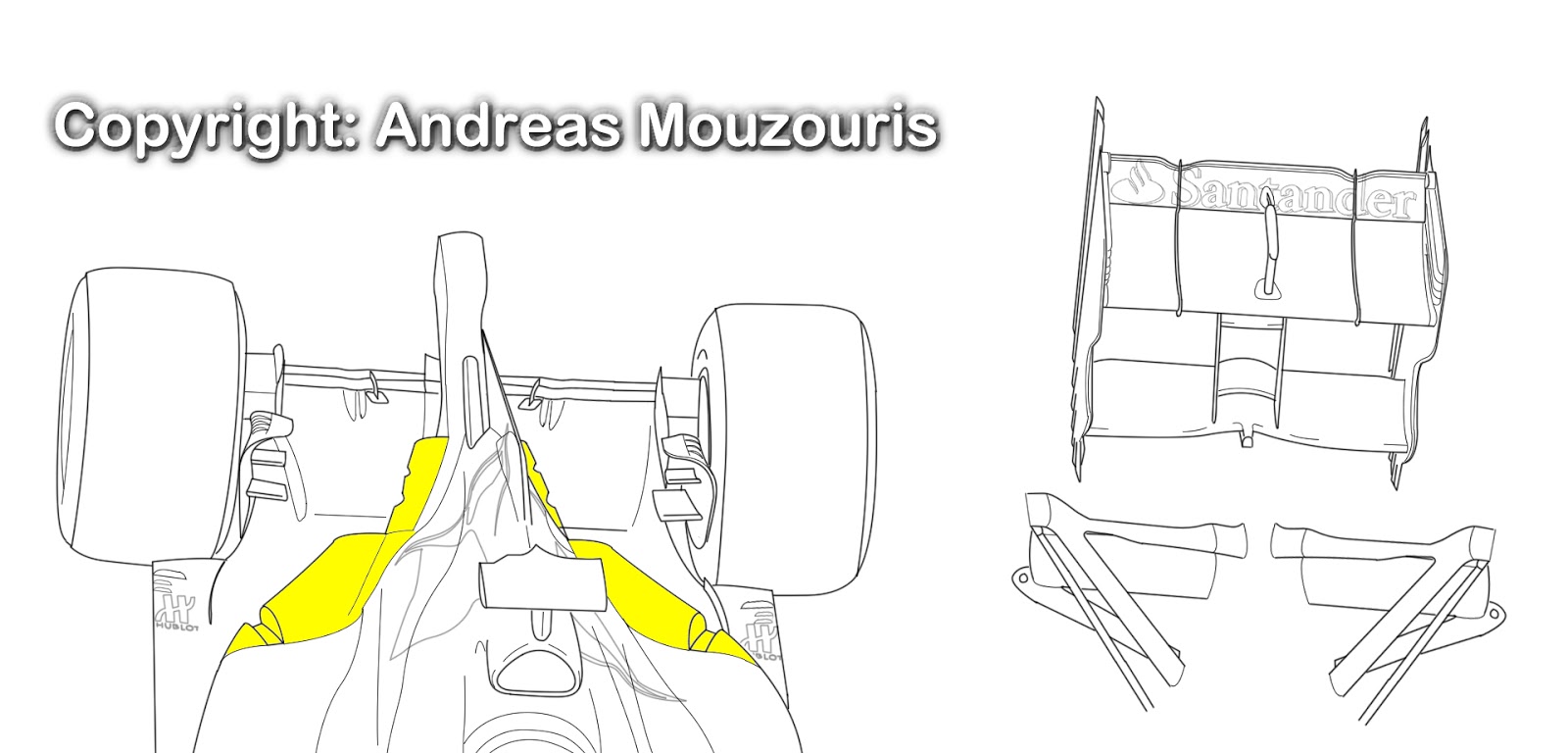
While the concept did not change, the new sidepods now bend down more. As a result the coanda ramp is now lower to better aim the exhaust plume towards the diffuser’s edge.  


New Sidepods

Old Sidepods
As well as a changed coanda ramp, the cooling outlets have changed.  In the following drawings I have moved the suspension and rear wing so that you can see what has changed more easily.

New Cooling Outlets

Old Cooling Outlets
The new version sports wider cooling outlets just behind the exhaust and coanda ramp while in the older version they were slimmer. However, in the original version which is very similar to the one present on the F2012, there was a second cooling outlet further back which also featured two cut-outs on each side. The second cooling outlet has now been removed, thus the need for the wider outlets behind the exhaust.

New

Old
 The new front wing was briefly seen on the second day of testing and brought back for the last day.

This new front wing adds yet another element on its outer tips, together with new cascade wings, endplates and the adjustable upper element.

New Front Wing

Old Front Wing
 The new element on the outer tips, allows the wing to curve outwards at a larger angle to create more downforce and direct a larger portion of the airflow around the wheels.
The new endplate is covering up a portion of the open area that allowed airflow flowing over the top of the wing to flow to the outside. This will create more downforce. As well as the new endplate, the footplate now features a slot which is an innovation by Ferrari it is the first time seen on a car, ever.

New Front Wing Endpate

Old Front Wing Endpate

 The new cascade element is no longer divided into two different parts, instead it is one winglet only much wider than before. The fence that divided the two cascade elements on the older version has now become a vertical fence which will induce a stronger vortex in the attempt two direct the airflow around the front wheels as efficiently as possible.
At the top of the endplate a smaller winglet has been added, similar to the one used by Red Bull. 

The inner adjustable element of the wing has been revised, with its inner extremities now taller than before.

Moving slightly upwards, we will find the new strake running along the sides of the nose that was first introduced in the last day of the first Barcelona test but was slightly revised in the second one. The strakes are there for legality purposes, so they were tested before Melbourne.


On the last day of testing, the team tested more new parts. On of which was the new rear wing. The wing now features smaller v-cutouts on the top of the upper element. In addition, the endplate has been revised and the gills are now slightly smaller than before. Those gills bleed the high pressure air from the inside of the wing to the outside, reducing drag by weakening the strength of the vortex shed at the wing tips.


The last new part tested was a new diffuser which still features the airfoil shaped gurney flap on top of the diffuser’s trailing edge, but it now curves downwards instead of stopping at the edges. Also, the diffuser no longer dips down where the two main vertical strakes are located. 


Friday, February 8, 2013

Ferrari F138 as seen in Jerez

When Ferrari revealed its new car, we saw a lot of differences to its predecessor, the F2012, although the sidepods and cooling layout are almost exactly the same. There are many differences, front and rear wings, slightly different front pull-rod suspension and a significantly different, slimmer rear end with a new gearbox and new suspension layout. One of the most apparent differences though is the nose of Ferrari’s 2013 challenger. Ferrari is one of many teams that opted use a modesty panel to cover the step despite the very small disadvantage of the weight of the carbon fiber up high which would have a negative effect on the CoG (Center of Gravity) of the car, as Red Bull, Sauber and Lotus argue. The step on the nose was created as a result of last year's regulation changes which did not allow the nose of the cars to extend above 550mm above the horizontal reference plane (the bottom of the wooden plank under the car) and 150mm forward from the front bulkhead. This rule was enforced to protect the driver's head in case of a t-bone crash as the crash structure protecting the driver is also 550mm above the reference plane. Compared to the F2012 the F138 has a slightly taller nose tip which allows more air under it and then under the floor to channel more air to the diffuser and produce more downforce. Below I have highlighted in yellow the area in which the nose is not allowed to enter which also gives an idea of where the modesty panel is.


Ferrari also kept the smaller radiator above the gearbox used to cool the oil. The smaller radiator is fed with air from a second intake behind the airbox (highlighted below):


This year though, the second intake is removable, or rather, changeable. It was rumoured that Ferrari would be testing a DRD (Drag Reduction Device), and this supports the rumours as they can increase the size of the intake to feed air to the DRD which acts as a fluidic switch to stall the rear wing at high speed and improve top speed. The system was innovated by Lotus in 2012 and extensively tested by them as well as Mercedes. More teams tested similar devices at last year’s Abu Dhabi young drivers test but has not yet been used successfully. It remains to see if Ferrari will use such a device. 

An innovation on the F138, are the vertical rear wing endplate slats. These vertical slats are there to improve extraction of air from the rear wing to improve its efficiency. In addition, the slats extend down and become part of the vertical strakes below under the rear wing end plate which work to turn the airflow behind the rear tires and reduce the turbulence behind the tire. 

In the following photos you can see vortices shed behind the rear wing of the F138. Vortices are usually visible when there is a lot of humidity or when it is damp, for example after it rains. To see vortices shed there though is very strange as it was neither damp nor too humid. Moreover, the vortices are shed at a very peculiar angle.


Those vortices are usually a sign of drag, but I suspect they might have something to do with the vertical slats on the rear wing.

The front wing is largely the same as the wing Ferrari ended 2012 with. The difference is that the upper flap is split into two more flaps about halfway from its attachment point. This is down to help keep the airflow attached below the wing and improve flow around the tires and towards the back of the car. 


2012 Front Wing
2013 Front Wing


The most interesting feature of the F138 is its very slim rear end. Compared to last year the gearbox is longer for this exact reason, to improve packaging and slim down the rear end. It is definitely the slimmest car at the rear of all the 2013 cars we have seen (Williams’ FW35 remains to be revealed). This is partly because of the slimmer, longer gearbox and partly because of the vertical configuration of the radiators which make the sidepods bulkier at the front but tighter towards the rear. Below you can see the car’s rear end colour-coded. 


The vertical strakes are there to manage the airflow on top of the diffuser to help extract more air out of it. The shroud housing part of the lower wishbone, the half-shaft and the track rod is also visible (Half Shaft Shroud) The brake ducts sport some new features, but are simpler than the ones used at the end of last season, so they are expected to be upgraded along with other parts of the car in the big upgrade package Ferrari will introduce in the last pre-season test in Barcelona. 


In the following drawing, the space freed up below the gearbox is visible. This will improve the airflow over the diffuser and out of the SMH (Starter Motor Hole) which helps in preventing the diffuser from stalling. The floor is now so far away from the gearbox they had to use two rods, one on each side (highlighted with red colour) and an inverse U shaped flow conditioner on top of the diffuser to improve its rigidity with the rest of the car (again highlighted with red color).


by Andreas Mouzouris

Monday, February 4, 2013

Half Shaft Shroud

Since 2009 Red Bull has used a fairing in different formats to cover the half shaft, the track rod (for adjusting toe angle) and half of the lower rear wishbone. The reason for this is that the rotation of the half shaft produces downforce because of the  Magnus Effect, which is good. The problem is that when you introduce the exhaust plume into the equation, this effect becomes more unstable as exhaust flow is given out by the engine only on every exhaust stroke. 


In addition, covering them will provide a clearer path for the airflow at the rear of the car allowing the diffuser to produce more downforce.


This year Ferrari, McLaren, Force India, Sauber, Lotus and Mercedes (up to the day of posting this) have followed Red Bull's path of using the half shaft shroud as it is more aerodynamic than having them separate.